
Practical survival guide
Minecraft Enchantments: Best Choices, Bookshelves, and How to Reroll
Minecraft enchantments are easiest to manage when you separate the table roll from the final anvil plan. Build a full bookshelf setup, spend only the levels you can replace, and treat the first offered enchantment as a clue rather than a promise. This guide gives a version-aware route for choosing useful sword, armor, tool, bow, and trident enchants without wasting rare books or a good diamond item.
The recommendations below describe normal Java and Bedrock survival. Names, caps, treasure rules, and command behavior can change with a release, so check the current in-game tooltip before committing a long-term world. Reviewed October 14, 2026.

Quick answer
How to Get Better Minecraft Enchantments
For a dependable survival setup, place an enchanting table with up to 15 bookshelves around it, leaving the required air gap, and bring lapis lazuli plus a spare item. The table's three offers are random, but the visible enchantment gives you useful information about that roll. If none of the three options helps, enchant a cheap book or tool to refresh the list, then return to the item you actually care about.
Use the enchanting table for early and mid-game upgrades, then use an anvil to combine compatible books and repair a planned item. A grindstone removes most applied enchantments and returns some experience, but it cannot preserve a single enchantment. Treasure enchantments, such as Mending, are normally found through loot or trading rather than a standard table roll. Do not assume a high level number means a better result: compatibility and the item's job matter more.
The best set depends on the task. A survival sword usually values durability, damage, and a compatible special edge; a pickaxe often starts with efficiency and durability; boots may need fall and movement protection; a bow needs a choice between Infinity and Mending. Java and Bedrock share the broad system but can differ in trade availability, combat details, and command syntax. Verify the installed edition and release before copying a list from an older guide.
Use the table as a filter
A 15-bookshelf room raises the level ceiling, but the offer is still a roll. Refresh poor offers with a low-cost item instead of burning a rare tool.
Finish with an anvil
Books let you target a specific plan and combine compatible effects. Watch the level cost and rename or merge items before the anvil says Too Expensive.
Keep a version boundary
Mending, treasure rules, villager trades, and combat effects can vary by edition or update. Use the current tooltip and official notes as the final check.
A repeatable setup
How to Enchant Items Without Wasting Levels
Use this sequence when a new world has diamonds but not yet a reliable supply of books, villagers, or experience.
1. Confirm the edition and job
Decide whether the item is for Java or Bedrock survival, a copied test world, or a server with special rules. Write down the job first: branch mining, melee, ranged combat, travel, or a long-term tool. The job tells you which effects are essential and which conflicts are acceptable.
2. Build the table room
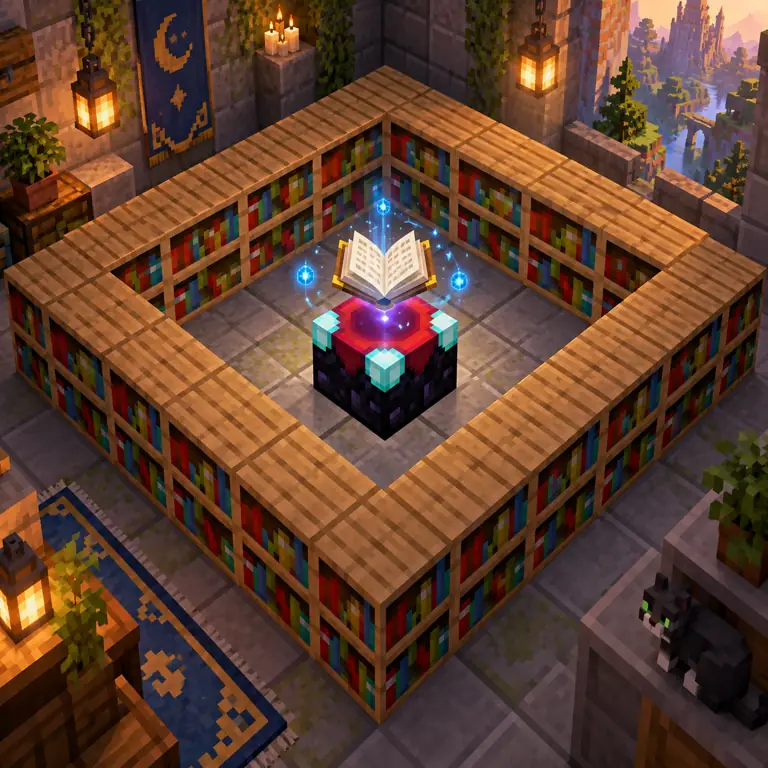
Craft the table, place up to 15 bookshelves around it with the required open space, and keep a safe path to the exit. Put chests for lapis, spare books, and cheap refresh items nearby. A clean room makes it easier to see whether a missing level is caused by layout, experience, or the item itself.
3. Roll on a cheap item first
Insert a low-cost book, stone tool, or spare iron item and read the offered enchantment. If the offers are poor, take the cheapest useful one to rotate the list. This spends a little experience but protects the diamond pickaxe or armor piece you intend to keep.
4. Gather books and villagers
Explore libraries, fish or loot when appropriate, and trade with Librarians only after checking the current edition's rules. A trade is useful because it lets you target an effect, but prices and restocking behavior can vary. Keep a backup world before changing a trading hall or locking a valuable offer.
5. Combine in a planned order
Use the anvil to merge books with the same effect, then apply the resulting book to the item when the cost is still reasonable. Put the most important book on the item first when a long sequence could push the prior-work penalty too high. Repair with matching materials or a second item only when the total cost remains practical.
6. Test before the main save
Try the finished item in a copied world or a controlled cave. Check durability, attack behavior, mining speed, fall damage, and any edition-specific interaction. Keep the seed and version in your notes so a later update does not make an old screenshot or command look like a universal rule.
Build the right station
How Many Bookshelves for a Level 30 Enchant?
The practical target is 15 bookshelves for the highest normal enchanting-table tier. The shelves should form a ring or an equivalent layout with one clear block of air between the table and the shelves; torches, carpets, blocks, or other objects in that channel can interrupt the connection. You do not need to surround the table on every side, and adding more than the effective maximum does not keep raising the level.
A level 30 offer is not a guarantee of three perfect effects. The displayed level is the cost tier, while the item, the roll, and compatibility determine the actual result. If the table never shows a high tier, check the bookshelf gap, your available experience, the lapis slot, and whether the item can receive the effect. Bedrock and Java can show different wording, so compare the current interface rather than an old screenshot.
The room is also a resource-management tool. Store lapis, books, and a cheap refresh item nearby, but leave enough space to retreat if a hostile mob enters. When villagers or an anvil are part of the plan, do not build the enchanting room inside an untested trading hall: workstation linking and pathing errors can turn a small layout change into a larger repair job.
Decision table
Best Enchantment Priorities by Item
Treat this as a starting plan, then check conflicts, edition rules, and the way you actually play.

Choose effects by job
Best Minecraft Enchantments for Combat, Mining, and Travel
For combat, start with the weapon you can replace. A sword used for caves and general mobs benefits from reliable damage and durability, while a specialized weapon may favor a different compatible effect. Keep a shield and food plan in mind; a perfect damage list does not fix poor positioning. When testing a new release, compare the tooltip and a short combat session before spending several books on a whole armor set.
For mining, Efficiency changes the feel of a tool immediately, and Durability reduces trips back to storage. Fortune and Silk Touch serve different goals, so many players keep two pickaxes rather than trying to force one tool to do everything. Mending is valuable for a long-term kit, but the way you obtain it can depend on loot, trading, and edition rules. A copied world is the right place to test a villager or an anvil sequence.
For armor and travel, general Protection is a sensible baseline when you do not know the next danger. Boots deserve their own decision because fall damage, movement, and water travel pull in different directions. A bow, crossbow, trident, or fishing rod should be chosen around the activity rather than a universal tier list. The strongest-looking effect is not always the one that saves resources in your world.
When an effect cannot be applied, that is usually a compatibility rule rather than a broken table. Check whether another enchantment conflicts, whether the item type is supported, and whether the book is already at its maximum level. The grindstone is useful for clearing an unwanted result, but it is not a selective editor: it removes the applied enchantment set together.
Before you spend levels
Common Minecraft Enchanting Mistakes
Most wasted levels come from a planning error rather than a rare bug.
Putting the diamond item in first
Roll a cheap book or tool to refresh the table. Protect the item whose material and mining time would be expensive to replace.
Treating level 30 as a perfect result
The number is a cost tier, not a promise of the best combination. Read the actual effects and keep a targeted book plan.
Ignoring anvil order
Repeated merges can increase the prior-work penalty. Combine compatible books in a sensible sequence and stop when the cost is no longer practical.
Copying an old edition list
Names, trade rules, caps, and combat details can change. Use the current tooltip and a copied test world before changing a main save.
Keep the setup stable
Related Minecraft Guides
These guides cover the edition, profile, and villager decisions that often sit beside an enchanting plan.
Java vs Bedrock
Compare edition differences before copying a combat, trading, or command tip.
Compare editionsInstall Java mods safely
Keep a separate profile when a mod changes tools, loot, or the way you test a world.
Open the profile guideVillager trading hall
Plan workstation linking and trade checks before building a Librarian route for targeted books.
Review villager setupPrimary references
Check the Current Rules in Your Edition
The guide keeps the practical decision in one place, while these references help confirm version-sensitive mechanics.
Minecraft enchanting overview
Official Minecraft guidance and feature context for enchanting items.
Open official articleMinecraft Help Center
Official support articles are useful when a release changes a mechanic or interface label.
Open support centerMinecraft Wiki: Enchanting
Community-maintained tables for conflicts, treasure status, and edition details; verify against your release.
Read community referenceMinecraft Wiki: Anvil mechanics
A reference for combining order, prior-work cost, and repair behavior.
Check anvil detailsFrequently asked questions
Minecraft Enchantments FAQ
How many bookshelves do I need for a level 30 enchantment in Minecraft?
Use up to 15 bookshelves with the required open gap between the shelves and the enchanting table. More shelves do not keep raising the normal table tier, and the layout can be interrupted by objects in that gap.
What are the best enchantments in Minecraft?
There is no single best list for every world. Efficiency and Durability are strong mining priorities, Protection and Durability are a practical armor baseline, and a sword, bow, or boots should be matched to the activity and edition.
How do I get better enchantments in Minecraft?
Build the 15-bookshelf setup, roll on a cheap item to refresh poor offers, and use targeted books through loot or trading. Read the actual offered effects instead of assuming that level 30 is automatically best.
Can I remove one enchantment from an item?
A grindstone removes the applied enchantment set and returns some experience, but it does not selectively keep one effect. Curses and certain special cases may not behave like ordinary enchantments.
Is Mending available from an enchanting table?
Mending is generally treated as a treasure enchantment rather than a normal table offer. Obtain it through the current edition's supported loot or trading paths and verify the release rules before building a villager hall.
Should I choose Fortune or Silk Touch on a pickaxe?
They support different jobs. Fortune increases eligible drops, while Silk Touch collects the block itself. Many players keep separate pickaxes so a single tool does not have to cover conflicting goals.
What is the best order for combining enchanted books?
Combine compatible books in a planned sequence, then apply the combined book when the anvil cost is reasonable. Repeated prior work can push the cost too high, so test the sequence in a copy before using rare materials.
Do Java and Bedrock enchantments work the same way?
The broad system is shared, but trade availability, wording, combat details, and command behavior can differ. Check the current tooltip and edition documentation for a main-world decision.